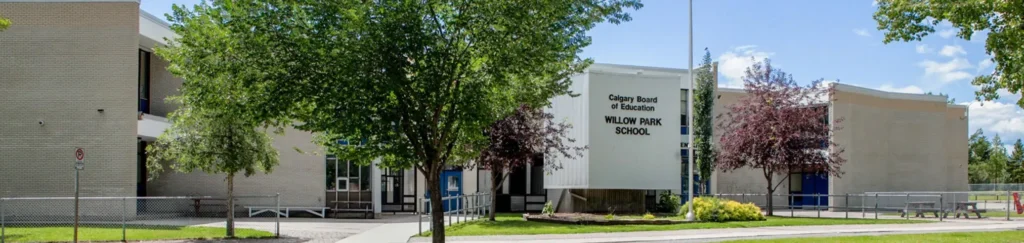
Most people drive past Willow Park School and see a neighbourhood school.
That’s only half the story.
Inside, the Willow Park School arts program is one families across South Calgary ask me about. And almost nobody explains how it actually works.
So let’s do that.
Willow Park School at a glance
- Address: 343 Willow Park Drive SE, Calgary
- Grades: 5 to 9 (middle school)
- Board: Calgary Board of Education
- Program: Arts-Centred Learning (a CBE alternative program)
- Phone: 403-777-6900
What the Willow Park School arts program really is
This is not an art class tacked onto the day.
The Calgary Board of Education describes Arts-Centred Learning as an alternative program that teaches the Alberta curriculum through arts-based inquiry. Students learn math, language and science through creative projects, and they work with artists along the way.
Willow Park describes it as learning in and through the arts. The arts become a way for kids to make sense of the world, and students show what they’ve learned in more than one way. A science concept might end up as a short film, a piece of drama or a visual project, not just a test.
The Alberta curriculum is the starting point. The goal is for students to go beyond the basic expectations, not around them.
The arts disciplines
Students work across five main areas, with literacy woven through all of them:
- Visual art
- Drama
- Dance
- Music (including music theory)
- Media arts
Process over product
This is the part that surprises parents the most. The school is clear that there is a greater emphasis on process than product.
In plain terms: your child doesn’t need to be the most talented artist in the room. What matters is inquiry, exploring, experimenting and reflecting on their work. Kids also learn to appreciate and critique their own art and their classmates’ art, which builds real confidence in giving and taking feedback.
What a typical year includes
- Arts-focused inquiry built around Alberta Education’s Programs of Study
- Students and teachers co-constructing knowledge through the arts
- Arts skills built into every subject, using both school and community resources
- Extended work with professional artists, for students and for staff
Art Core Experience (ACE): the Friday afternoon kids talk about
If you ask a Willow Park student about the program, there’s a good chance they’ll mention ACE.
The Art Core Experience is a 1.5-hour block every Friday where students learn a specific art skill they can carry back into their regular classes. Here’s how it works:
- 25 different art skills are taught over the year, across drama, art, music, theory and dance
- A different teacher every Friday, so students get time with each Fine Arts teacher
- Five rounds of five weeks. After each round, teachers evaluate and build a fresh set of skills for the next one
- Students rotate through grade groupings, so they mix with kids beyond their own class
- Students give feedback at the end of each round, and that feedback helps shape what comes next
- Activities are documented on an ACE website that students, parents and teachers can follow
For parents, ACE is a big part of why the program feels different. It isn’t one art teacher doing everything. It’s the whole staff contributing their specialties.
Who’s teaching
Willow Park highlights the range of creative backgrounds on its staff. Teachers include published authors, playwrights and poets, professional musicians, filmmakers, designers and cooks, along with plenty of passionate art enthusiasts.
That matters. Kids learn from people who actually make things.
Is the Willow Park School arts program right for your child?
Be honest with yourself here. The school says the program is much more demanding than a regular program, and it moves at a fast pace.
According to Willow Park, the students who do best tend to have:
- A genuine interest and passion for the arts
- Initiative, imagination and creative problem-solving
- The ability to handle a fast-paced, demanding program
- Motivation and independence, working both on their own and in groups
- Respect for other students’ creativity
Notice what’s not on the list: natural talent. A curious, motivated kid who loves to create will often do better here than a gifted artist who doesn’t want to stretch.
The CBE also publishes a guide called Is Arts-Centred Learning the Right Choice for My Child? It’s worth reading together with your child before you apply.
Willow Park also adds daily PE, second-language opportunities and character education. It offers Career Technology Foundations courses in foods, robotics and communication technology too.
How to apply to the Willow Park School arts program
Here’s the part families miss: you don’t just show up and register.
Alternative programs have their own process. You submit an Expression of Interest through the CBE’s SchoolEngage system, complete every section and upload the required documents.
In the 2025 round, the timeline looked like this:
- Registration opened: January 13
- Registration closed: noon on February 11
- Lottery drawn: February 12
- Results sent: within 10 business days, by February 27
- Your answer: accept or decline within 10 business days of the offer
Dates change each year, so check the CBE website for the current round.
One tip I give every family. If you applied to more than one lottery program, wait until you’ve heard back from all of them before you accept any.
What it costs
You pay the standard CBE fees. On top of that, families pay up to $85 a year for the artists in residence.
Arts field trips, performances and other activities may cost extra too. Ask the school what a typical year looks like.
Getting there
Grade 5 students can ride a CBE yellow bus. Students in grades 6 to 9 can use yellow bus service or a Calgary Transit pass.
Here’s the catch. Buses use congregated stops, so your stop may not be a short walk from your door. Families pay an annual bus fee or buy monthly transit passes.
What this means if you’re buying
Here’s what I tell buyers.
Each home address has a designated alternative program school. The CBE’s Find a School tool shows yours. Check it before you write an offer, not after.
And don’t buy a home counting on a spot. Treat the program as a bonus, not a given, and make sure the house works for your family even if you don’t get in.
Related reading: Willow Park Calgary real estate: a buyer’s guide · Willow Park golf course, estates or original 1960s home? · Willow Park Golf & Country Club guide · What’s my Willow Park home worth?
If you’re trying to figure out whether Willow Park fits your family, tell me what matters most to you. I’ll tell you honestly what I’d look at.
Cole Porter · 403.992.5445. cole@jamienewton.ca